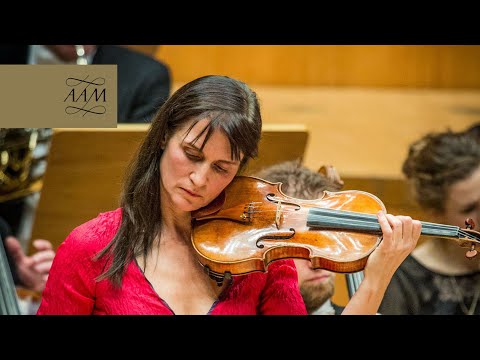
Viktoria Mullova
Your profile, built from Spotify + Wikipedia/Wikidata + your indexed library.
Back
Born / died
1959
Movement
20th-century classical
Location
Worked in London
Friends / contemporaries
Alexander Melnikov, Alexander Vedernikov, Gidon Kremer +3 more
genres: baroque, concerto, classical, chamber music · followers: 10,562
Viktoria Mullova is a violinist primarily known for her great virtuosity and a wide-ranging repertory that includes many crossover pieces.Spotify
On the serious side, she has been praised for her interpretations of various solo works by J.S. Bach, including the partitas and sonatas, as well as her readings of concertos by Brahms, Prokofiev (No.Spotify
2), Shostakovich (No. 1), and Sibelius. Her forays into more popular realms have included pieces by the Beatles, Miles Davis, and Duke Ellington.Spotify
Over the years, Mullova has developed a reputation for her highly individual interpretations and for her ability to communicate with her concert audiences. She has also grown to favor historically correct instruments and practices. Mullova was born on November 27, 1959, in Zhukovskiy, in the Moscow Oblast, then part of the Soviet Republic.Spotify
She studied music at the Central Music School of Moscow, where her most important teacher was Volodar Bronin. She later studied with violin virtuoso Leonid Kogan at the Moscow Conservatory. Mullova had a meteoric rise owing to spectacular wins at two major competitions: in 1980, she took first prize at the Jean Sibelius International Violin Competition, and two years later won the gold medal at the International Tchaikovsky Competition.Spotify
The following year, she defected to the U.S. but eventually settled in England, where she lives with her husband, cellist Matthew Barley. In the 1980s, Mullova made a number of highly successful recordings for Philips, including her first in 1985, with Seiji Ozawa and the Boston Symphony Orchestra, which paired the Tchaikovsky and Sibelius concertos. She followed that success in 1988 with another containing the Prokofiev Second and Shostakovich First, with André Previn and the Royal Philharmonic Orchestra.Spotify
By the end of that decade, she had appeared to great acclaim with many of the most important orchestras and conductors in the U.S., Europe, and East Asia. In 1994, she founded the Mullova Chamber Ensemble, a group that quickly achieved international renown. After her marriage to Barley, Mullova developed an interest, through him, in jazz and other popular styles of music.Spotify
In 2000, taking inspiration from a series of popular music concerts she gave on tour, Mullova made a recording for Philips entitled Through the Looking Glass, on which she performed music by Davis, Ellington, George Harrison, and other non-classical figures. Moving to the Onyx label in 2005, Mullova has steadily continued to issue recordings; among these are Bach: Sonatas (2007) with Ottavio Dantone, Peasant Girl (2011), and Music We Love (2020) with her son, bassist Misha Mullov-Abbado. In 2022, Mullova moved to the Signum Classics label for a historical-instrument reading of music by Schubert, with Alasdair Beatson, who has become a regular collaborator, on fortepiano.Spotify
Mullova performs on the "Jules Falk" Stradivarius from 1723 and a 1750 Guadagnini violin.Spotify
~ Robert Cummings & Keith Finke, Rovi
role: unknown · 20%era: Modernmovement: 20th-century classical1959
Movement
20th-century classical · Wikipedia
20th-century classical music is Western art music that was written between 1901 and 2000, inclusive. Musical style diverged during the 20th century as it never had previously, so this century was without a dominant style. Modernism, impressionism, and post-romanticism can all be traced to the decades before the turn of the 20th century, but can be included because they evolved beyond the musical boundaries of the 19th-century styles that were part of the earlier common practice period. Neoclassicism and expressionism came mostly after 1900. Minimalism started later in the century and can be seen as a change from the modern to postmodern era, although some date postmodernism from as early as about 1930. Aleatory, atonality, serialism, musique concrète, and electronic music were all developed during the century. Jazz and ethnic folk music became important influences on many composers during this century.
How this movement sounds
new harmoniesnew rhythmsneoclassicismatonalityminimalismsharp contrasts
20th-century classical listening cues: variety and experimentation. Some music keeps older forms (neoclassicism) but with sharper harmonies, leaner textures, and motoric rhythms.
Other strands move toward atonality (no clear tonal center) or explore new scales and sonorities; rhythm can become more complex, more mechanical, or more jagged.
Timbre and texture are often treated as structural elements: changes in sound color can function like 'harmonic' events.
A practical way to listen: instead of expecting a 'tune', track motives (tiny cells), rhythm, and register. Modern pieces often build form by transforming small units rather than by long melodies.
Minimalism is another common thread: repetition, gradual change, and a focus on pulse and process over long spans.
How Viktoria Mullova sounds
new harmonyrhythmic bitecolor & textureminimal patternsextended techniques
Modern/contemporary music varies wildly, but you will often hear experimentation with harmony, rhythm, and sound color as primary material.
Some strands emphasize rhythmic bite and sharp contrasts; others explore timbre and atmosphere; minimalism builds from repeating patterns and gradual change.
If the music feels less about singable melody and more about texture, pulse, or color, you are probably hearing a modern idiom.
Wikipedia
Viktoria Yurievna Mullova (Russian: Виктория Юрьевна Муллова, IPA: [vʲɪˈktorʲɪjə ˈmuləvə]; born 27 November 1959) is a Russian-born British violinist.Wikipedia
She is best known for her performances and recordings of a number of violin concerti, compositions by J.S. Bach, and her innovative interpretations of popular and jazz compositions by Miles Davis, Duke Ellington, The Beatles, and others.Wikipedia
Study resources & scores
Curated study material and indexed score links related to Viktoria Mullova.
No related study resources yet. As more lectures, transcripts, and scores are indexed, they will show up here.
Local matches
Matches your current indexed library (videos table). This will be sparse until connectors run.
Play video
YouTube · published 2021-02-12 · 1h 30m
Viktoria Mullova: Bach & Haydn | Academy of Ancient Music [Full Concert]
FreeFull concertLongLive
Saved playlist songs
Tracks from your saved Spotify playlist that are attributable to Viktoria Mullova.
No Spotify playlist is seeded yet.
No attributable tracks for this person in your saved playlist songs yet.