Vanessa-Mae
Your profile, built from Spotify + Wikipedia/Wikidata + your indexed library.
Born / died
1978
Movement
Contemporary classical
Location
Lived in Zermatt
Friends / contemporaries
Lang Lang, Yuja Wang, Akira Kosemura +3 more
role: unknown · 20%era: Contemporarymovement: Contemporary classical1978
Movement
Contemporary classical · Wikipedia
Contemporary classical music is Western art music composed close to the present day. At the beginning of the 21st century, it commonly referred to the post-1945 post-tonal music after the death of Anton Webern, and included serial music, electronic music, experimental music, and minimalist music. Newer forms include spectral music and post-minimalism.
How this movement sounds
texture-firstextended techniqueshybrid stylessound colorspace/silencemicro-detail
Contemporary classical listening cues: sound color and texture can matter as much as melody and harmony. Sometimes the 'main theme' is a texture rather than a tune.
You may hear extended techniques (unusual ways of playing), hybrid influences (film, jazz, folk, electronics), or very sparse, spacious writing where silence and resonance carry meaning.
Because styles vary widely, try to identify the piece's 'rules': what repeats, what changes gradually, and what counts as a structural event (a new texture, a new register, a new pulse).
A useful mindset: contemporary music can be about attention, not just about singable melody. Treat tiny changes (a new bow pressure, a shifted harmony color, a new layer) as the 'plot'.
If it feels unfamiliar, focus on one layer (a repeating figure, a bass pulse, a timbre) and track its evolution. Contemporary music often rewards close listening to small changes.
How Vanessa-Mae sounds
new harmonyrhythmic bitecolor & textureminimal patternsextended techniques
Modern/contemporary music varies wildly, but you will often hear experimentation with harmony, rhythm, and sound color as primary material.
Some strands emphasize rhythmic bite and sharp contrasts; others explore timbre and atmosphere; minimalism builds from repeating patterns and gradual change.
If the music feels less about singable melody and more about texture, pulse, or color, you are probably hearing a modern idiom.
Wikipedia
Vanessa-Mae (Chinese: 陈美; pinyin: Chén Měi; born 27 October 1978), also called Vanessa-Mae Vanakorn Nicholson, is a Singaporean-born British violinist and skier with Thai heritage from her father.Wikipedia
Her album sales reached several million by 2006, making her the wealthiest entertainer aged under 30 in the United Kingdom at that time. She is known for fusing classical and popular genres, which she calls "violin techno-acoustic fusion".Wikipedia
This crossover style combines her classical violin training with electronic music influences like techno and synth-pop, as seen for example in the title track from her album Storm from 1997. As a skier, she competed under the name Vanessa Vanakorn (Thai: วาเนสซ่า วรรณกร, romanized: Wa-nes-sa Wan-na-kon; her father's surname) for Thailand in alpine skiing at the 2014 Winter Olympics. She was initially banned from skiing by the International Ski Federation (FIS) after participating in a qualifying race allegedly organised to enable her to qualify for the Winter Olympics.Wikipedia
An appeal to the Court of Arbitration for Sport led to the ban being nullified, citing lack of evidence for her own wrongdoing or any manipulation. The FIS later issued an apology to her.Wikipedia
Study resources & scores
Curated study material and indexed score links related to Vanessa-Mae.
No related study resources yet. As more lectures, transcripts, and scores are indexed, they will show up here.
Local matches
Matches your current indexed library (videos table). This will be sparse until connectors run.
 Play video
YouTube · published 2023-02-12 · 1h 4m
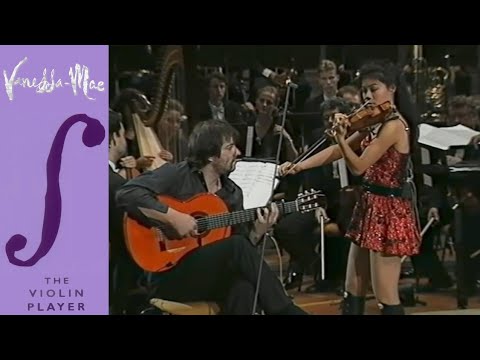
Vanessa-Mae: Live at the Berlin Philharmonie,The Classical Concert, 1996🎻🎶✨
FreeFull concertLongLive
Saved playlist songs
Tracks from your saved Spotify playlist that are attributable to Vanessa-Mae.
No Spotify playlist is seeded yet.
No attributable tracks for this person in your saved playlist songs yet.