Maxim Vengerov
Your profile, built from Spotify + Wikipedia/Wikidata + your indexed library.
Back
Born / died
1974
Movement
20th-century classical
Location
Born in Novosibirsk
Friends / contemporaries
Michael Nyman, Alain Lefèvre, Alexander Melnikov +3 more
The Soviet-born violinist Maxim Vengerov has been one of the most successful modern exponents of the great Russian school, marrying flawless technique acquired early in life to broad musical curiosity.Spotify
He has been increasingly often active as a conductor. Vengerov was born August 20, 1974, in Novosibirsk, in Siberia, where his father was an oboist in the local symphony orchestra.Spotify
His mother ran an orphanage and conducted its choir. Vengerov took up the violin at four and, of his own volition, would practice for hours after dinner. The child was enrolled in lessons with a strict local teacher with whom he clashed; he refused to play, but then when his mother broke down in tears, he suddenly picked up his violin and played 17 pieces from memory without interruption.Spotify
At seven, the Soviet government moved Vengerov to Moscow for special musical studies. His teacher was Zakhar Bron, whose tuition led the youngster to a win at the 1984 Junior Wieniawski Competition in Poland. Vengerov followed Bron to London and then to Lübeck, Germany.Spotify
In his teens Vengerov was already playing concertos with top European orchestras such as the Concertgebouw in Amsterdam; he made his U.S. debut with the New York Philharmonic in 1991. Vengerov's recording career began in the late 1980s, and in 1992 he signed with the Teldec label. A major breakthrough was a 1994 recording of violin concertos by Shostakovich and Prokofiev, with Mstislav Rostropovich conducting the London Symphony Orchestra; it won two Gramophone awards in Britain and snared two Grammy nominations in the U.S.Spotify
In 1997, Vengerov was named Envoy for Music of the United Nations' Children's Emergency Fund (UNICEF), the first classical musician to hold the post. He signed with the EMI label in 2000, and for Teldec or EMI he has recorded almost all the major violin concertos. Unlike many other violinists from the former Eastern Bloc, Vengerov cultivates a wide variety of musical interests that include Baroque works, jazz, and rock.Spotify
His pace of recordings and performances on the violin was slowed somewhat by a shoulder injury sustained in a 2005 weightlifting accident, but he used the layoff to develop his interest and skills in conducting. In 2010, he became chief conductor of the Menuhin Festival Gstaad Orchestra, and he completed several courses in orchestral and operatic conducting. Vengerov has also taught violin at the Menuhin Institute in Switzerland and the Royal College of Music in London.Spotify
In 2019, as a violinist, he released an album of works by Kreisler and Chinese composer Chen Qigang with the Shanghai Symphony Orchestra. An Israeli citizen, Vengerov lives with his family in Monaco. He owns the "ex-Kreutzer" Stradivarius violin, which he plays with a bow once owned by Jascha Heifetz.Spotify
role: interpreter · 90%instrument: conductorera: Modernmovement: 20th-century classical1974
Movement
20th-century classical · Wikipedia
20th-century classical music is Western art music that was written between 1901 and 2000, inclusive. Musical style diverged during the 20th century as it never had previously, so this century was without a dominant style. Modernism, impressionism, and post-romanticism can all be traced to the decades before the turn of the 20th century, but can be included because they evolved beyond the musical boundaries of the 19th-century styles that were part of the earlier common practice period. Neoclassicism and expressionism came mostly after 1900. Minimalism started later in the century and can be seen as a change from the modern to postmodern era, although some date postmodernism from as early as about 1930. Aleatory, atonality, serialism, musique concrète, and electronic music were all developed during the century. Jazz and ethnic folk music became important influences on many composers during this century.
How this movement sounds
new harmoniesnew rhythmsneoclassicismatonalityminimalismsharp contrasts
20th-century classical listening cues: variety and experimentation. Some music keeps older forms (neoclassicism) but with sharper harmonies, leaner textures, and motoric rhythms.
Other strands move toward atonality (no clear tonal center) or explore new scales and sonorities; rhythm can become more complex, more mechanical, or more jagged.
Timbre and texture are often treated as structural elements: changes in sound color can function like 'harmonic' events.
A practical way to listen: instead of expecting a 'tune', track motives (tiny cells), rhythm, and register. Modern pieces often build form by transforming small units rather than by long melodies.
Minimalism is another common thread: repetition, gradual change, and a focus on pulse and process over long spans.
How Maxim Vengerov sounds
new harmonyrhythmic bitecolor & textureminimal patternsextended techniques
Modern/contemporary music varies wildly, but you will often hear experimentation with harmony, rhythm, and sound color as primary material.
Some strands emphasize rhythmic bite and sharp contrasts; others explore timbre and atmosphere; minimalism builds from repeating patterns and gradual change.
If the music feels less about singable melody and more about texture, pulse, or color, you are probably hearing a modern idiom.
Wikipedia
Maxim Alexandrovich Vengerov (Russian: Максим Александрович Венгеров; born 20 August 1974) is a Soviet-born Israeli violinist, violist, and conductor.Wikipedia
Classic FM has called him "one of the greatest violinists in the world". Vengerov was born in Novosibirsk, the only child of Aleksandr and Larisa Borisovna, an oboist and orphanage children's choir director, respectively.Wikipedia
He began his musical journey early, singing in his mother's choir at the age of three and starting violin lessons at five with Galina Turchaninova. At age 10, Vengerov won the 1984 International Karol Lipiński and Henryk Wieniawski Young Violin Player Competition, marking the start of his career. He subsequently studied with Zakhar Bron, following him from the Soviet Union to the Royal Academy of Music in London and then to the Musikhochschule Lübeck in Germany.Wikipedia
In 1990, Vengerov won the International Carl Flesch Competition, securing a recording contract with Teldec and launching his international career. Vengerov moved to Israel with his family in 1990, continuing his studies at the Jerusalem Academy of Music and Dance. In 2006, he founded the Musicians of Tomorrow school in northern Israel.Wikipedia
His career also includes contributions as a conductor and educator, serving as the first chief conductor of the Menuhin Festival Gstaad Orchestra and holding professorships at institutions like the Royal College of Music…Wikipedia
YouTube (channel bio)
The Official YouTube Channel of Violinist Maxim Vengerov.YouTube
Management enquiries: Nicola-Fee Bahl | General Manager (concerts) M:+44 (0)79 6800 6163 E: nicola-fee@nfbm.com Berin Iglesias Art | Germany & Russia Königsallee 60F, 40212 Düsseldorf (Germany) M: +49 152 02197452 M: +49 172 2752904 E: r.schwarzstein@berin-iglesias.art E: ceo@berinart.de Lionel Tan | Social Media & Website Manager M: +44 (0)73 6755 3352 E: lionel@maximvengerov.comYouTube
Interview highlights
Built from indexed interview/masterclass transcripts (podcasts / YouTube). Quotes are direct excerpts with source links.
Interview highlights for Maxim Vengerov from 1 source. Quotes below are direct excerpts; open the source link for context.
Topics that recur (auto): Music, Always, First, Violin, Life, Great, Then, Play.
Source: youtube_captions · TFCHG8fTMio · 0:00 · Open source
My name is Maxim Vengerov and this is Living the Creative Life. Today we share an exclusive conversation with violinist Maxim Vengerov, a living legend of his generation. Here at Rare Violins of New York, 38 floors above Carnegie Hall we catch Maxim between master classes and performances for a look at his life and work. Maxim, it's a delight to welcome you here to Living the Creative Life. Thank you so much for joining me. Zsolt, thanks for having me. I wanted to focus on what we can give to the younger generation and I had the privilege and joy of just witnessing here in New York City, where we are, right next door in Carnegie Hall, this masterclass that you were leading with young students and I perceived that this was among other things an exercise in how to react to the moment, how to react to life and music. You were singing for us, you were playing for us, you were dancing around, you were showing us the Minuet, and you were encouraging the students you were encouraging the studentsto have good humor. Was this the approach of your teachers? I think all of them did something in different ways. I really had the training of a combat fighter from every part of the area that one could need in music, because music is life. Music is not only art. For me it just stands above every - the profession for me, music is like - when I go on stage is really like living the moment and anything can happen. Living dangerously. One could call it a Russian roulette. How much are you feeling the presence of the teachers you had? Technically speaking, I had learned my technique so solidly from the early years that it is really deeply engraved in my body, my mind. I just always have to adapt it a little bit, because the body naturally has its changes. Galina Turchaninova was always for me is always the point of reference where I always come back. And this is beautiful because this connection with the instrument, this Franco-Belgian school - what is the essence of Franco-Belgian schools and subsequently became Russian school - is the connection between the sounds, this legato with the beautiful right hand connections and the vibrato, using the right muscles when you need to use them and not using others when you don't need. The Franco-Belgian school is one of the greatest, just name Wieniawski, Vieuxtemps and Ysaÿe, Kreisler, Heifetz... for instance Galina Turchaninova she gave me all her love for music and she didn't want to touch my musicality, strangely enough. She just gave me all the tools I needed to work. I learned the instrument at the age of five without actually knowing how I did it like a child that started speaking language. So for me playing violin, holding it, was something extremely natural. But she let me always do and express myself in music the way I wanted. Now when I came to study with professor Bron after five years, he already insisted on his own view and he actually imposed his views, interpretations and he wanted to change a lot of technical things. I always asked why, why should I change that? And so we had a bit of battle. So it was a rocky road with him. But on the other hand it offered me an immunity to stand for my views, to defend my views, and also to be able to listen and process very quickly what can become mine and what not. I learned to filter at the very early age what I love and what I like less and about learning to filter. What I hear you describing is a truly rigorous training. If we're putting on our battle armor, ideally perhaps the student learns that critical voice to advance their level. But that can probably get in the way on stage. Is that an easy mechanism for you to take yourself out of this self-critical mode to live into what we were seeing in your class, the joy of making music? I think stage is one place and platform where I'm finally liberated. Because, look, you stand in the room. You practice. It's not always joyful. Especially when I was a child I hated practicing because I had to do it for seven, eight hours a day. It was the training I wouldn't wish for my kids. But thanks to this training also at the age of seven I already possessed the necessary skills to perform all the major concertos if I wanted to. Now today I enjoy practicing much more because I just love it, because it's always reconnecting with the violin, with my soul mate. my partner, taking the violin. And sometimes I look at it and I say no, no, not now, not now. I will wait. And I watch a movie, I read a book, and then only when my body and my mind tells me now is the moment, now or never, I jump to the violin and I start playing. And then this connection is really overwhelming. And this connection comes on stage with me together, because after you learn something, you go on stage, you feel like you are a horse ready for the race but it's not the time yet - so you just go like this. Finally when you go on stage and you're liberated. Your spirit must be liberated. How about dealing with situations where there is a direct judgment? For example you as a young child, you had some successes with competitions. I was never spoiled in that regard. I always had competitors, always. and I learned to like having competitors because it was like this - My first competition I won in Siberia, Novosibirsk. I didn't quite win it, I shared the first prize. I was so offended, my god, my goodness! I didn't understand why I should be sharing the prize. Then I went to play the renowned competition for young violinists in Lublin in Poland, and again I shared the first prize. And only when I came to England and I really won the competition in the London Karl Flesch competition I totally hated the feeling of being alone. First of all I genuinely didn't think I was going to win because everybody around me played so beautifully. I was just practicing in the little hotel where there were rooms like this, back to back, and I had two Chinese guys practicing Tchaikovsky concerto simultaneously, like a stereo effect, and I was stuck between them. They were so good! So I said, I will not have any chance. And then all of a sudden they called me for the first prize. I felt kind of even embarrassed that I wanted and how. So if that was the feeling - and just to share this, I think this feeling made me humble. In my life music is about sharing. It's not to win To some degree of course it involves the sports element, but it's an art, and there is so many artists around. And everyone has the right and can express him or herself in their own way, and it's wonderful to share this art, to play together to make chamber music. This is what I learned from my wonderful teachers like from Mstislav Rostropovich. Music is about sharing first of all. So speaking of competitions and the young people you encounter in today's world - I perceive that there is a certain amount of pressure in succeeding rather quickly, competitions, establishing a name, establishing some degree of momentum. Is there also maybe a benefit in not going so quickly, not succeeding right away? The right timing is everything. For instance if you're a teacher and you say, you know it's not yet the time and you don't put any pressure on the student to learn something quick, again it depends up to the student. Everything has to be tailor made. I taught for number of years and I know everyone is different. Some people need pressure. They can't be without pressure, without pressure they just collapse. And some people, the pressure they are allergic to it. So I'm allergic to pressure. I think it's due to the fact that I was born and raised in Soviet Union that had this rigid system. For me music was always about love and expression and freedom, and there I had to go on stage everywhere, not only in Soviet Union but go outside. When I was about 11, 12, we started traveling. It was not about me anymore, it was about the country, and I hated that to some degree because first of all I had to practice more, and at night. And secondly, this pressure is unnecessary pressure. I think the second competition that I did, Karl Flesch, even though I wanted it, was unnecessary pressure because I didn't need competitions anymore, not for myself. I think you need competition as a great goal for a young person to study repertoire, because it's only in the competition you have to prepare for three or four rounds. You have to prepare all the capricious Pagani virtuoso works, sonatas, two concertos - and this is good. But I would leave it at that and then give the platform to musicians just to perform and share. But giving prizes feels always painful for me. First of all you have number of jury members and everyone listens differently. I've been chairing for many times. Everyone listens differently. Music is a form of an art that you cannot touch, and everyone has different ears. It's a matter of taste you cannot identify exactly. You cannot say this is great and this is not so great, and even intonation - you take the intonation and one person can say no, intonation is something that is really evident. No it's not. I made an experiment without announcing who is playing before the first round of the competition in Poznan. I presented to my fellow honorable members of the jury five versions of Scherzo tarantella by Wieniawski, Heifetz, Milstein, Menuhin, Isaac Stern, and Oistrakh and said is this in tune? No, this is absolutely not in tune. And we were struck that every musician had different intonation. But different intonation, that's what made them so personal. Because if everyone will have the same intonation then everybody would be - this is already moving towards artificial intelligence. So you described this unnecessary pressure and then at some point hopefully we learn to react against it. Is that where humor comes in? I was I was observing in your master class, you would actually instruct the students: now would be a good moment to smile, now would be the moment where with your left eye you look this way to your colleague and then you give them a nice little surprise - is that where you developed this reactive sense of humor? Music is fun. I always had so much great fun with music. Especially when I came to the West and I felt sort of liberated, not only in travel conditions geographically, but also I started meeting musicians. When I met Rostropovich he became like musical father for me. From the first lesson was always images. He would never tell me what to play and how to play, but would translate everything into images, and images would stay with me. He was an incredible person that had such a vivid imagination and always put the score first for him. And he taught me when you play Beethoven you cannot play yourself. You have to try and express Beethoven. Try actually, think, that you are Beethoven for the time that you interpret the work. So for me, playing concertos or right now I’m in Mozart because we did this great project with our first chamber orchestra, two evenings of complete Mozart concertos in Carnegie Hall. So for some weeks I was really working on Mozart to the extent that you go on stage and you try to visualize you are Mozart you're wearing a wig. That's what I try to transmit always to students - offer us audiences a voyage, a time travel. Because in a certain degree music offers this time machine. It's a time machine. When we play Baroque music, when we play Shostakovich, we go to another area - to darkness if we speak about his 10th symphony or First violin concerto or 8th quartet. So we cannot just be today and play ourselves and take the music and express ourselves. No, we have to offer that. For me a musician to a certain degree has to be also an actor. We're talking about a life which is so immersed in our passion. Hundreds of concerts a year. I hear colleagues describe perhaps a yearly or even a daily process of wanting to quit or at least step away. What's the value in stepping away from what we do in growth, or perhaps finding an inner strength? I think it's important always to take distance. I remember at some point when I was 25 I felt that I needed a change in my life. it was always violin, violin, violin. I said no, it cannot be only about violin, I need to become more rounded musician. Having such great teachers like I had just to name two, Rostropovich and Barenboim, for me the bar was very high. They weren't just great instrumentalists but they were conductors, and Rostropovich was a fabulous pianist as well. Speaking to them, they feel so humble. Rostropovich said yes, I even composed four quartets, two cello concertos. But I burned them in the chimney. How could you? He said well, next to Shostakovich I couldn't have the guts to release these works. So for me having such great teachers always put everything in perspective. So when I was 23, 24, I said yes, I definitely need to move on. And I took viola and in nine months I prepared for the Walton concerto which I recorded with Slava - with Rostropovich - and LSO Symphony Orchestra along with the Britten violin machete. And I noticed when I came back to the violin that my colors on the violin changed. They became deeper, because my palette of colors, like the painter's, became much richer. I inherited more colors just from another profession. Then I said I definitely I have to move on. And for brief amount of time, like two years, I studied Baroque, I played the period instrument. I started with Trevor Pinnock, we did the great tours where in the same concert we played the period instruments and then the modern again. From that point of view, when I now play Bach on the normal instrument and I don't play in the Baroque I can use this barolo technique and these colors subsequently. Then I remember I was 22, recording with Daniel Barenboim Brahms violin concerto with Chicago Symphony and the first rehearsals in piano rehearsal Danny would point out few things in the score, saying, look you see this is how violin must merge the sound and really has with his horn section. Can you try that? So I tried. Not quite there. Now the flutes are playing, you shouldn't be playing violin anymore but you should have the color of flute, and now this is cellos, can you change? And I didn't quite get it. In the end of rehearsal he said, well, this will come only when you will start conducting. And then I took seven years of conducting classes with Yuri Semenov who was for 16 years the chief conductor of Bolshoi Opera in Moscow. And in the end of the studies I even conducted Eugene Onegin. And that again gave me perspective, great perspective, to to speak the same language with conductor, with orchestra, totally different experience. And to conclude with a joyful note - Are there any moments in your life on stage in front of a public or in the practice room where you felt suddenly as though you were in the presence of the sublime? I always feel very humbled by the opportunity that life has given me to be with my music every day. I remember when I was a little kid, first of all observing my mother being a choir conductor and a teacher. She was a prolific musician in Siberia. She founded her orphanage where she organized the music school there, and she helped lots of kids, she rescued them from streets and she offered them great alternative: music. And I saw in my own eyes how music incredibly and profoundly affected these kids. So basically after having nothing they had everything. They had life and they had music. And if you think about that - musicians, we're so lucky that from early on we have the greatest tool to better ourselves every day. Because music what it means, music is great discipline. We have to work on our spirituality, on our physics, is everything all in one and from early ages of course. Everything comes with a huge responsibility, because nothing is ever guaranteed. Musicians have to start so early on, at the age of four or five, some start a little later but at some point it may be too late, because being a violinist involves a very small motor muscles. And even if you became good violinist at the age of 17 you don't have a guarantee you're going to become professional. So you have to love music unconditionally and treat this profession as not only your profession, but as your philosophy of life, as your - doesn't replace religion, but close to it definitely - and at such moments today when we have the instabilities in every field of our life I feel ever blessed that I’m allowed to go in front of audience and offer this amazing travel and experience for audience, for people that need, using greatest music by so much legendary composers. This is a true, true blessing of my life. Maxim, thank you so much for joining me. It was a pleasure, and I was so moved to also have the opportunity to witness you passing along these messages to young people who will be benefiting so much from our conversation. Thank you so much.
Transcript sources (1)
Source: youtube_captions · en
Indexed: 2026-02-11T07:53:46.312Z
Study resources & scores
Curated study material and indexed score links related to Maxim Vengerov.
No related study resources yet. As more lectures, transcripts, and scores are indexed, they will show up here.
Local matches
Matches your current indexed library (videos table). This will be sparse until connectors run.
Play video
Carnegie Hall · published 2026-05-15 · 1h 24m
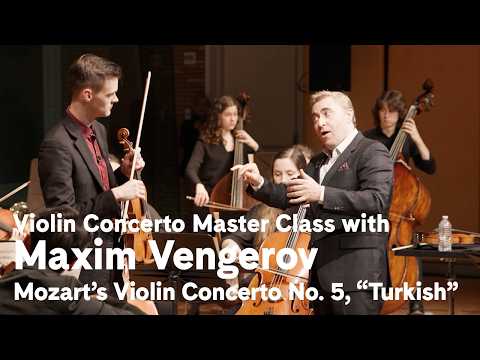
Violin Concerto Master Class with Maxim Vengerov: Mozart’s Violin Concerto No. 5, "Turkish"
2026Concerto1h 24m
FreeFull concertLong
Play video
Carnegie Hall · published 2026-05-15 · 1h 20m
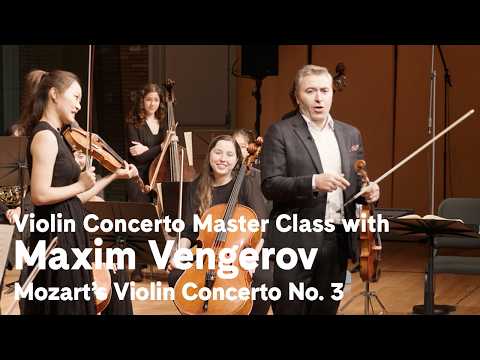
Violin Concerto Master Class with Maxim Vengerov: Mozart’s Violin Concerto No. 3
2026Concerto1h 20m
FreeFull concertLong
Play video
Carnegie Hall · published 2026-02-19 · 3m
Maxim Vengerov: 2026–2027 Carnegie Hall Perspectives Artist
Free
Play video
YouTube · published 2025-08-15 · 36m
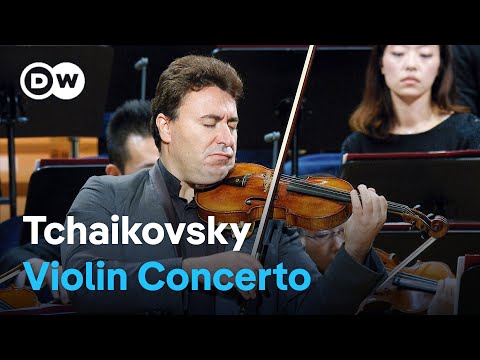
Tchaikovsky: Violin Concerto | Maxim Vengerov (violin), Long Yu & the Shanghai Symphony Orchestra
2025ConcertoSymphony36m
FreeLongLive
Play video
Carnegie Hall · published 2025-05-16 · 2m
Maxim Vengerov: 2025–2026 Carnegie Hall Perspectives Artist
Free
Play video
Carnegie Hall · published 2024-04-29 · 3m
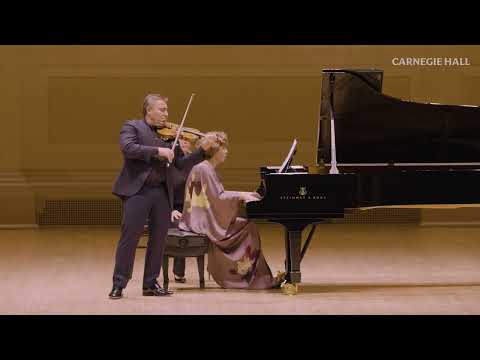
Maxim Vengerov and Polina Osetinskaya: Brahms “FAE” Sonata Scherzo at Carnegie Hall | From the Stage
2024Sonata3m
Free
Saved playlist songs
Tracks from your saved Spotify playlist that are attributable to Maxim Vengerov.
No Spotify playlist is seeded yet.
No attributable tracks for this person in your saved playlist songs yet.