Edvard Grieg
Your profile, built from Spotify + Wikipedia/Wikidata + your indexed library.
Born / died
1843-1907
Movement
Romantic
Location
Born in Bergen
Friends / contemporaries
Robert Schumann, Bedrich Smetana, Anton Webern +3 more

Norway's most famous composer, Edvard Grieg was one of the late Romantics whose music was infused with the folk tradition of his homeland.Spotify
He dedicated his career to the pursuit of a national sound. The respect he had for his predecessors illustrates the sincerity with which he worked towards this goal.Spotify
He wrote in the Romantic tradition with, in his own words, the determination to "create a national form of music, which could give the Norwegian people an identity." The clear mountain beauty of a Scandinavian landscape can be felt in the pure modal harmonies and sustained transparent textures combined with the warmth of a Schumannesque melodic sensibility. This is especially true of his hundreds of piano miniatures -- many based on folk dance rhythms -- and his songs. Grieg was actually of Scottish descent on his father's side, but his family had fully assimilated into Norwegian culture.Spotify
As a youth Grieg studied the folk tunes of his native country. He left his home in Bergen to study at the conservatory in Leipzig. There he began his formal musical education under the auspices of Ignaz Moscheles (piano) and Carl Reinecke (composition).Spotify
Despite being diagnosed with a form of tuberculosis, which left him with only one functioning lung, Grieg graduated from the conservatory in 1862. The composer had an intense desire to develop a national style of composition, but recognized the importance of becoming well versed in the work of the European masters, and consequently relocated to Copenhagen, studying with Niels Gade. He was thus able to remain in Scandinavia, while working in a thriving cultural center.Spotify
In 1867 against his family's better judgment, Grieg married his cousin Nina Hagerup, a talented pianist, but whose vocal abilities enchanted the composer even more. She inspired many of his 170 songs. Shortly after their wedding, the couple moved to Oslo, where Grieg supported them by teaching piano and conducting.Spotify
He and his wife traveled extensively throughout Europe and it was during a period of time spent in Denmark, the composer wrote his landmark opus, the Piano Concerto in A minor. The premiere was given in 1869, with Edmund Neupert as the soloist and was received with an enthusiasm that would attach itself to the composer's reputation for the remainder of his career. It rivals Tchaikovsky's Piano Concerto No.Spotify
1 in its drama, virtuosity, and popularity. Grieg admired his literary contemporaries and forged a productive partnership with Björnstjerne Björnson, playwright and poet, with whom he staged performances of such works as Before a Southern Convent, and Bergliot. While Björnson struggled with his output, Grieg met and befriended Henrik Ibsen.Spotify
The forthcoming collaboration would prove significant for both, as Grieg would supply incidental music to Ibsen's Peer Gynt for an early 1876 production. The premiere was performed to critical acclaim, although the music was not exactly what Ibsen had hoped, and eventually led to Grieg's scoring of Peer Gynt into the popular Suites 1 and 2 (1888 and 1893 respectively) for full orchestra. As a result, Grieg enjoyed tremendous celebrity and continued to travel extensively, often meeting internationally renowned composers such as Tchaikovsky, Brahms, and Liszt, among others.Spotify
In addition to a grant he was awarded in 1874, Grieg was able to earn the majority of his money by adhering to a vigorous schedule of recital tours and conducting engagements. He served briefly as the music director of the Bergen Symphony Orchestra, and from 1880-1882, held the same position at the Bergen Harmonien. Another popular suite, From Holberg's Time -- for piano or for orchestra -- was composed in 1884 and pays homage to the music of Baroque era.Spotify
In 1885, Grieg and his wife relocated once again, this time back to Bergen, where he built their celebrated home, Troldhaugen. The property, a popular tourist destination to this day, features a secondary building overlooking the water, which the composer used as his work area, as he could only work in solitude. Grieg and his wife summered in Norway and departed each fall for European tours that would last the remainder of the year.Spotify
He was adored wherever he traveled and lived at a pace that would eventually catch up with him. Grieg died of chronic fatigue, with much credit given to his lifelong health problems, in his hometown in 1907.Spotify
~ David Brensilver, Rovi
role: composer · 90%era: Romanticmovement: Romantic1843–1907
Movement
Romantic
How this movement sounds
rubatochromatic harmonybig climaxesricher timbrelong lyrical linesnarrative feel
Romantic listening cues: heightened emotion, longer lyrical melodies, and more freedom with rubato (flexible timing) in performance.
Harmony is often more chromatic, with colorful chords and side-steps that create tension and release over longer spans. You may hear more delayed resolutions and more 'yearning' harmonic motion.
Dynamics and texture often expand: thicker sonorities, bigger climaxes, and a strong sense of narrative or character (even in purely instrumental music).
In piano music, listen for the use of pedaling and resonance to create a halo around harmony; in orchestral music, listen for richer timbre and denser voicing (inner lines matter).
A useful trick: follow the bass line. In Romantic music it often shapes the drama, pulling the harmony through longer arcs rather than short phrase punctuation.
How Edvard Grieg sounds
rubatorich harmonylong melodybig dynamicscoloristic pedal
Romantic music tends to foreground emotion and color: long singing melodies, flexible tempo (rubato), and harmony that stretches and sighs.
You often hear thicker textures, wider dynamic range, and a more "orchestral" use of the piano with deep bass and resonant pedaling.
Look for heightened contrast and personal voice: the same musical gesture can feel intimate one moment and heroic the next.
Wikipedia
Edvard Hagerup Grieg ( GREEG; Norwegian: [ˈɛdvaʁd ˈhɑ̀ːɡəʁʉp ˈɡʁɪgː]; 15 June 1843 – 4 September 1907) was a Norwegian composer and pianist.Wikipedia
He is widely considered one of the leading Romantic era composers, and his music is part of the standard classical repertoire worldwide. His use of Norwegian folk music in his own compositions brought the music of Norway to fame, as well as helping to develop a national identity, much as Jean Sibelius did in Finland and Bedřich Smetana in Bohemia.Wikipedia
Grieg is the most celebrated person from the city of Bergen, with numerous statues that depict his image and many cultural entities named after him: the city's largest concert building (Grieg Hall), its most advanced music school (Grieg Academy) and its professional choir (Edvard Grieg Kor). The Edvard Grieg Museum at Grieg's former home, Troldhaugen, is dedicated to his legacy.Wikipedia
Study resources & scores
Curated study material and indexed score links related to Edvard Grieg.
No related study resources yet. As more lectures, transcripts, and scores are indexed, they will show up here.
Local matches
Matches your current indexed library (videos table). This will be sparse until connectors run.


France Musique · published 2026-09-04
Une heure et plus, un compositeur : Edvard Grieg
2026
Free

France Musique · published 2026-08-01
Lucas Debargue et Victor Julien-Laferrière en duo à La Roque d'Anthéron
2026
FreeFull concert


France Musique · published 2026-06-13
France Musique est à vous du samedi 13 juin 2026
2026
Free

France Musique · published 2026-06-04
Le pianiste Radu Lupu joue les concertos de Grieg et Schumann
2026
FreeFull concert

France Musique · published 2026-05-15
Lars Vogt dans le Concerto pour piano d'Edvard Grieg
2026Concerto
FreeFull concert

France Musique · published 2026-03-27
Kirsten Flagstad chante 10 mélodies de Grieg en concert, en 1957
1957
FreeFull concert
 Play video
YouTube · published 2025-08-15 · 31m
Brown University Orchestra // Robert Shlyakhtenko, piano // Edvard Grieg: Piano Concerto
2025Concerto31m
FreeLongLive
 Play video
YouTube · published 2025-08-05 · 15m
Edvard Grieg's Peer Gynt Suite No. 1 | Minnesota Orchestra | Thomas Søndergård
FreeLive
 Play video
YouTube · published 2025-06-10 · 32m
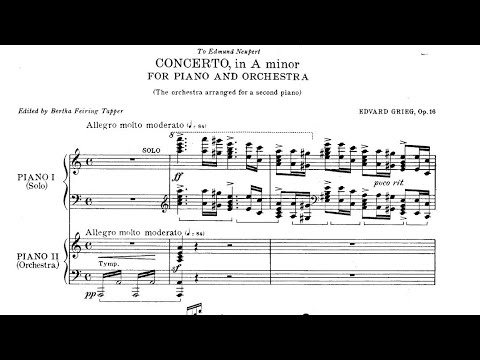
EDVARD GRIEG, PIANO CONCERTO OP.16 A-minor [full concert-detailed review]
2025ConcertoOp.32m
FreeLongLive
 Play video
YouTube · published 2022-08-06 · 29m
Edvard Grieg - Piano Concerto, Op. 16 (1868) {Andsnes Live}
2022ConcertoOp.29m
FreeLongLive
 Play video
YouTube · published 2022-07-16 · 18m
Edvard Grieg: Lyric Suite. Edward Gardner and Bergen Philharmonic
FreeLive
 Play video
Zurich Chamber Orchestra (Zuercher Kammerorchester) · published 2022-05-21 · 6m
Sommergrüsse vom ZKO - Edvard Grieg: «Air», aus: Aus Holbergs Zeit — Suite im alten Stil Op. 40
2022SuiteOp.6m
FreeLive
 Play video
Zurich Chamber Orchestra (Zuercher Kammerorchester) · published 2022-05-21 · 7m
Grüsse vom ZKO: Edvard Grieg: Intermezzo, aus: Streichquartett g-Moll op. 27
FreeLive
 Play video
YouTube · published 2021-08-06 · 34m
Fall Concert: Peer Gynt by Edvard Grieg
202134m
FreeLongLive
Play videoYouTube · published 2021-07-20
Sommergrüsse vom ZKO - Edvard Grieg: «Air», aus: Aus Holbergs Zeit — Suite im alten Stil Op. 40
2021SuiteOp.
Free
Play videoYouTube · published 2021-06-04
Grüsse vom ZKO: Edvard Grieg: Intermezzo, aus: Streichquartett g-Moll op. 27
Free
 Play video
YouTube · published 2021-05-28 · 48m
Online Student Piano Recital | Program #1 presented by Edvard Grieg Society of MN
202148m
FreeFull concertLongLive
 Play video
Zurich Chamber Orchestra (Zuercher Kammerorchester) · published 2021-05-21 · 3m
Frühlingsgrüsse vom ZKO - Edvard Grieg: «Preludium», aus: Aus Holbergs Zeit
20213m
FreeLive
Play videoYouTube · published 2021-04-23
Frühlingsgrüsse vom ZKO - Edvard Grieg: «Preludium», aus: Aus Holbergs Zeit
2021
Free
Saved playlist songs
Tracks from your saved Spotify playlist that are attributable to Edvard Grieg.
No Spotify playlist is seeded yet.
No attributable tracks for this person in your saved playlist songs yet.