Dinu Lipatti
Your profile, built from Spotify + Wikipedia/Wikidata + your indexed library.
Born / died
1917-1950
Movement
20th-century classical
Location
Born in Bucharest
Friends / contemporaries
Anna Holbling, Bernard Haitink, Daniel Barenboim +3 more

role: unknown · 20%era: Modernmovement: 20th-century classical1917–1950
Movement
20th-century classical
How this movement sounds
new harmoniesnew rhythmsneoclassicismatonalityminimalismsharp contrasts
20th-century classical listening cues: variety and experimentation. Some music keeps older forms (neoclassicism) but with sharper harmonies, leaner textures, and motoric rhythms.
Other strands move toward atonality (no clear tonal center) or explore new scales and sonorities; rhythm can become more complex, more mechanical, or more jagged.
Timbre and texture are often treated as structural elements: changes in sound color can function like 'harmonic' events.
A practical way to listen: instead of expecting a 'tune', track motives (tiny cells), rhythm, and register. Modern pieces often build form by transforming small units rather than by long melodies.
Minimalism is another common thread: repetition, gradual change, and a focus on pulse and process over long spans.
How Dinu Lipatti sounds
new harmonyrhythmic bitecolor & textureminimal patternsextended techniques
Modern/contemporary music varies wildly, but you will often hear experimentation with harmony, rhythm, and sound color as primary material.
Some strands emphasize rhythmic bite and sharp contrasts; others explore timbre and atmosphere; minimalism builds from repeating patterns and gradual change.
If the music feels less about singable melody and more about texture, pulse, or color, you are probably hearing a modern idiom.
Wikipedia
Constantin "Dinu" Lipatti (Romanian pronunciation: [ˈdinu liˈpati] ; 1 April [O.S.Wikipedia
19 March] 1917 – 2 December 1950) was a Romanian classical pianist and composer whose career was cut short by his death from effects related to Hodgkin's disease at age 33. He was elected posthumously to the Romanian Academy.Wikipedia
He composed few works, all of which demonstrated a strong influence from Hungarian composer Béla Bartok. A relentless perfectionist, Lipatti often prepared many years for major performances, such as four years for Beethoven's Piano Concerto No. 5 and three for Tchaikovsky's Piano Concerto No.Wikipedia
1. He left a small number of recordings, and they are well-regarded, particularly that of Alborada del gracioso from Ravel's Miroirs suite. In his short lifetime he was highly acclaimed by prominent musical figures of the 20th century, including Yehudi Menuhin, Alfred Cortot, Nadia Boulanger, and Francis Poulenc.Wikipedia
Study resources & scores
Curated study material and indexed score links related to Dinu Lipatti.
No related study resources yet. As more lectures, transcripts, and scores are indexed, they will show up here.
Local matches
Matches your current indexed library (videos table). This will be sparse until connectors run.

France Musique · published 2026-09-11
France Musique est à vous du vendredi 11 septembre 2026
2026
FreeFull concert

France Musique · published 2026-09-06
François Sureau, écrivain : "Je m'assieds dans l'avion à côté d'un homme ressemblant fort à Vladimir Horowitz..."
2026
Free
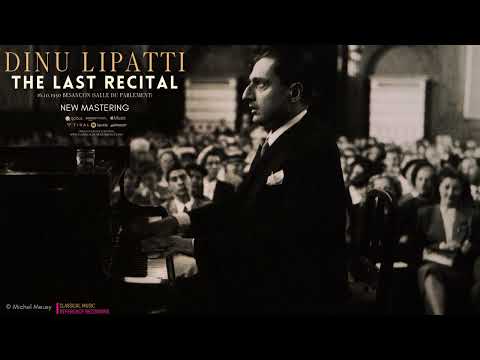 Play video
YouTube · published 2024-03-13 · 1h 21m
Dinu Lipatti: The Last Recital at Besançon (Bach, Mozart, Schubert & Chopin) (Century's recording)
FreeFull concertLongLive
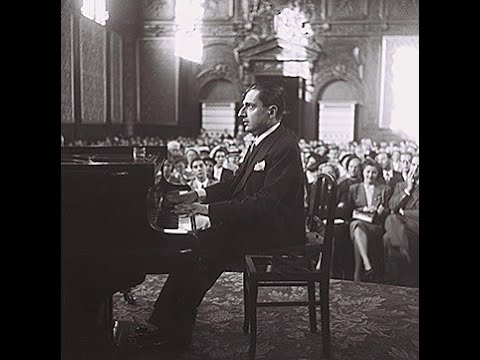 Play video
YouTube · published 2020-02-13 · 52m
Ultimul recital, Dinu Lipatti, Besançon 1950, un documentar de Philippe Roger, subtitrat în română
195052m
FreeFull concertLongLive
Saved playlist songs
Tracks from your saved Spotify playlist that are attributable to Dinu Lipatti.
No Spotify playlist is seeded yet.
No attributable tracks for this person in your saved playlist songs yet.